


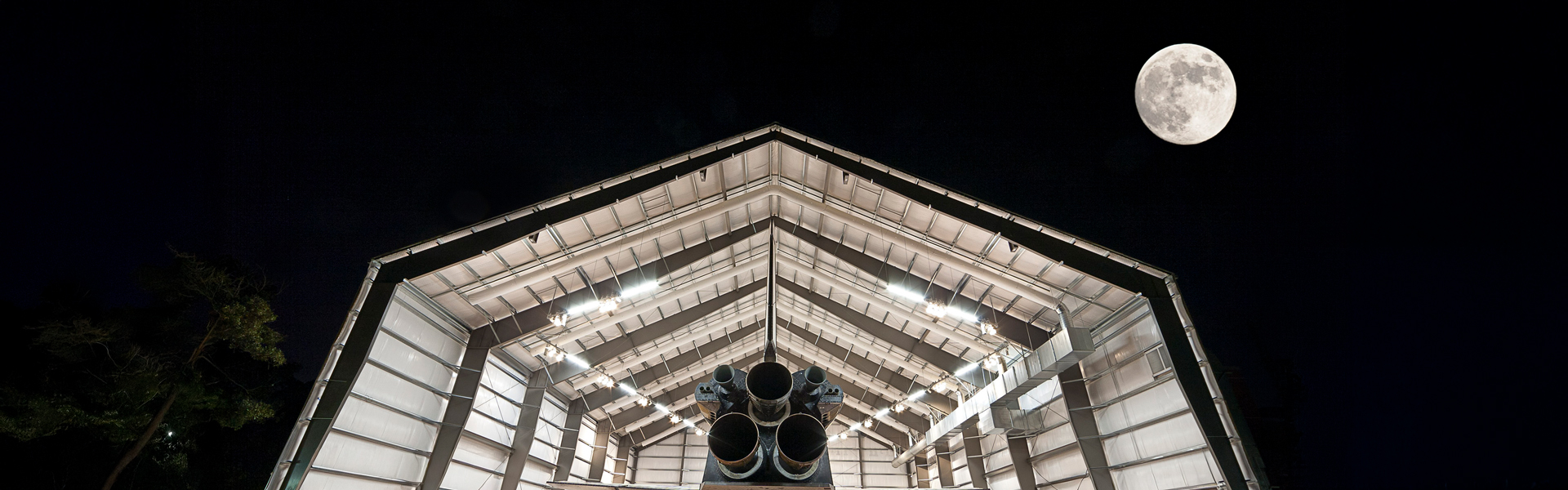
California Science Center – Samuel Oschin Pavilion
A code-compliant, large-span structure was needed to house a retired Space Shuttle under an aggressive timeline. The Butler® structural system delivered the strength, precision and adaptable design needed to meet logistical demands and rapid public opening.


Project
Overview
When the California Science Center was selected to host the decommissioned Space Shuttle Endeavour, the museum faced a clear technical mandate. It needed a fully enclosed, code-compliant structure capable of protecting a 120-foot wingspan and 65-foot vertical tail—designed, approved and erected in less than 18 months. The solution required precision, speed and absolute reliability.
A temporary facility was the only viable path given the timeline, and as engineering requirements became clear — seismic performance, wind resistance, deflection control and conditioned interior space — the museum team shifted toward a more robust, proven system: A Butler building.


According to Tony Budrovich from the California Science Center, “We actually found that from an engineering standpoint, we needed a building we could construct but then open to drive a shuttle into. So it started pushing us toward a Butler building.”
Working with Morley Construction, the Science Center partnered with T. Violé Construction Co., a Butler Builder® with deep aviation and specialty-structure experience. The Butler system quickly demonstrated advantages in structural performance, cost efficiency and code compliance.
“We had some very strict seismic, wind, drift and deflection requirements that we needed to comply with. Honestly, I don’t think the fabric structure would have been able to meet these stringent specifications,” said Tim Violé of T. Violé Construction Co.
The final design utilized a Butler clearspan structural system to achieve a column-free interior, along with a removable rigid-frame endwall to accommodate the shuttle’s entry. Butler Manufacturing™ completed the structural engineering, collaborating with Zimmer Gunsul Frasca (ZGF) to align design intent with system capabilities.
The 120-by-180-foot pavilion features a ridge height of 68 feet. To meet Title 24 energy requirements, the structure incorporates the insulation levels necessary for a fully air-conditioned environment.
The site itself introduced further constraints. Located just 20 feet from the main museum, the project required disciplined logistics and precise erection sequencing.
“The site was logistically without much room to erect a building. We had literally no lay down area. We had to build the building’s roof sections in modules on the slab and assemble and stack them prior to lifting them in place, all in a very limited area,” said Violé.
The pre-engineered nature of the Butler system accelerated field operations. Inland Erectors completed the five-month erection with a level of efficiency and control ideally suited to the project’s constraints.
Ten days after the shuttle was moved into the structure, the facility opened to the public — an outcome made possible by a system engineered for predictable performance and erectability.
Through ramping and good logistics, the Butler building worked ideally. Literally ten days after we brought the shuttle into the building, we were opening a public presentation space. Those types of timelines just don’t work with most buildings.
Inside the pavilion — now known as the Samuel Oschin Space Shuttle Endeavour Display Pavilion — visitors transition from the museum’s “California Story” exhibit into a purpose-built environment designed to showcase the shuttle with clarity and impact.
“At that point we get the wow experience. They take one step into the door, and mouths drop, eyes open, and everyone wants the family photos,” Budrovich said.
When the permanent facility opens on the museum’s campus, the Butler building will be disassembled and repurposed. Until then, Endeavour remains protected within a structure engineered for strength, adaptability and long-term resilience.


