


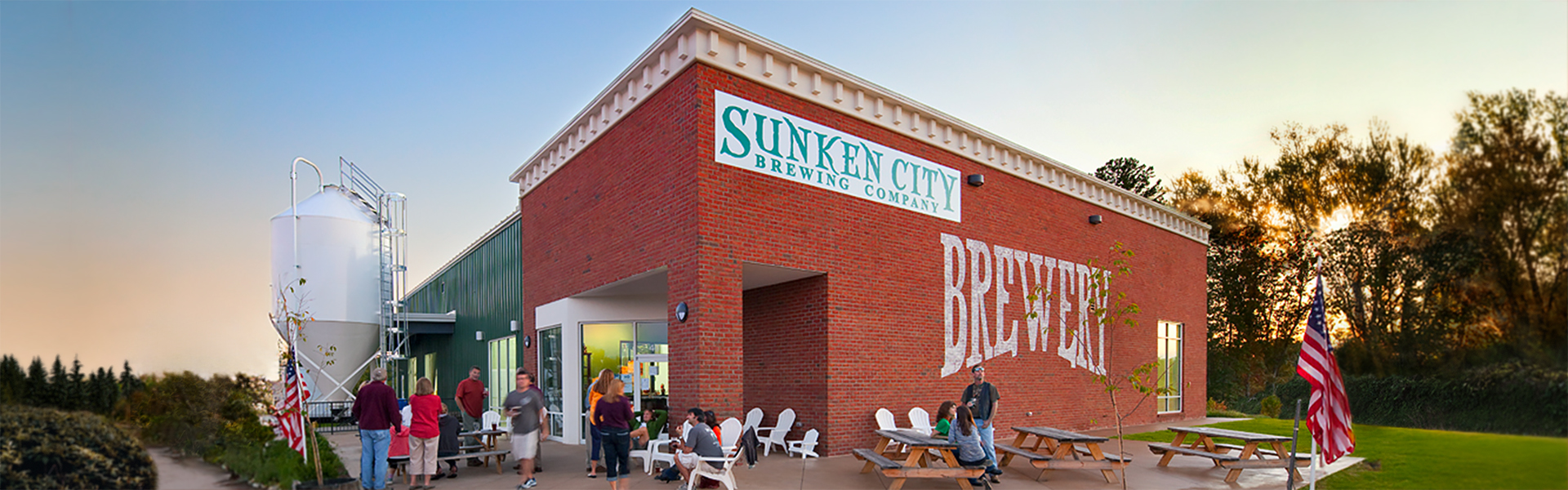
Sunken City Brewing Company
A growing microbrewery relocates to a purpose-built facility engineered for expansion, efficiency and community connection — demonstrating how thoughtful design can elevate production, visitor experience and long-term business potential.


Project
Overview
Sunken City Brewing Company carries the name of a small community submerged in flooding in the mid-1960s. After several years of operating in nearby Roanoke, Va., brewery owner and area resident Jerome Parnell sought to return the business to the region that inspired it.
The new facility needed to reflect the character of the community, support Sunken City’s nine employees and provide capacity for long-term growth. To achieve that, Parnell selected Avis Construction Company, Inc., a contractor and Butler Builder®, to guide the project.
Avis recommended Butler® building systems to meet Parnell’s goal of developing a structure capable of serving current production needs while streamlining future expansion.


“It made sense to invest in a building that provided the flexibility to expand our footprint later,” Parnell said. “The room for growth was one of the main benefits of choosing a Butler building.”
The 8,720-square-foot brewery dedicates most of its footprint to the brewhouse, fermentation area and canning room, with the remaining space designed for visitors through a tasting room, pub, retail area and beer garden.
Efficient production required unobstructed interior volume and a tall ceiling to accommodate brewing equipment. Brewmaster Jeremy Kirby needed a wide, open layout that maintained separation between the manufacturing area and public space, while still allowing visitors to see the brewing process.
Avis recommended Butler's clearspan structural system to achieve the required openness. The original plan included a column at the rear of the manufacturing zone, but the design team reconfigured that approach using the clearspan framing system — one of multiple Butler options — to maximize operational flexibility.
Avis worked closely with Parnell and Kirby to configure equipment placement to support a logical, efficient production flow.
“Many craft beer makers started out of their basements and grew into larger facilities that weren’t technically well-thought-out,” Parnell said. “We wanted this facility to be state-of-the-art, where everything had its place.”
A 22-foot ceiling height enables the brewery to expand vertically as production demands evolve. Although the fermentation area currently supports 50-barrel tanks, the additional height allows for future installation of 80- to 100-barrel tanks. Regulatory and process requirements influenced the room layout as well. Separate boiler and milling rooms isolate heat and grain processing from the brewing area.
“It was important that the boiler and milling areas were sealed off from the brewing area and that rooms were constructed accordingly,” said Troy Smith of Avis. “When you’re constructing a space that creates a consumable product, it’s important to follow every regulation to the letter.”
I’m impressed with how solid and insulated the structure is. We’ve been able to maintain fairly cool temperatures in the summer and warm temperatures in the winter.
The Butlerib® II wall system provided the flexibility needed for a retail-oriented façade. A brick exterior was added along the tasting room and beer garden to reinforce the customer experience.
Avis recommended the MR-24® roof system for its weathertight performance and ability to protect the brewing equipment below. The system’s movable clips accommodate thermal expansion, while factory-punched panels support precise installation. The MR-24 roof system also allowed clean transitions to the brick façade, strengthening both performance and aesthetics.
The selected wall and roof systems met new state energy codes that took effect just as plans were submitted for approval. The MR-24 roof system supported an additional layer of insulation required by the updated standards. Daylighting strategies further reduced energy use. Skylights, windows, a Butlerib II translucent wall panel and frosted glazing bring natural light into the workspace, decreasing the reliance on electric lighting during the day. Combined with the cool roof color and enhanced insulation, these elements contribute to lower utility costs.
“I’m impressed with how solid and insulated the structure is,” Parnell said. “We’ve been able to maintain fairly cool temperatures in the summer and warm temperatures in the winter.”
Construction was completed in March 2013, and the grand opening took place in May 2014 to coincide with American Craft Beer Week. Sunken City doubled production within the first four months.
“This building is well-made, and it’s configured in a way that let us look toward the future,” Parnell said, “and that sets us apart from other breweries of our size.”


