


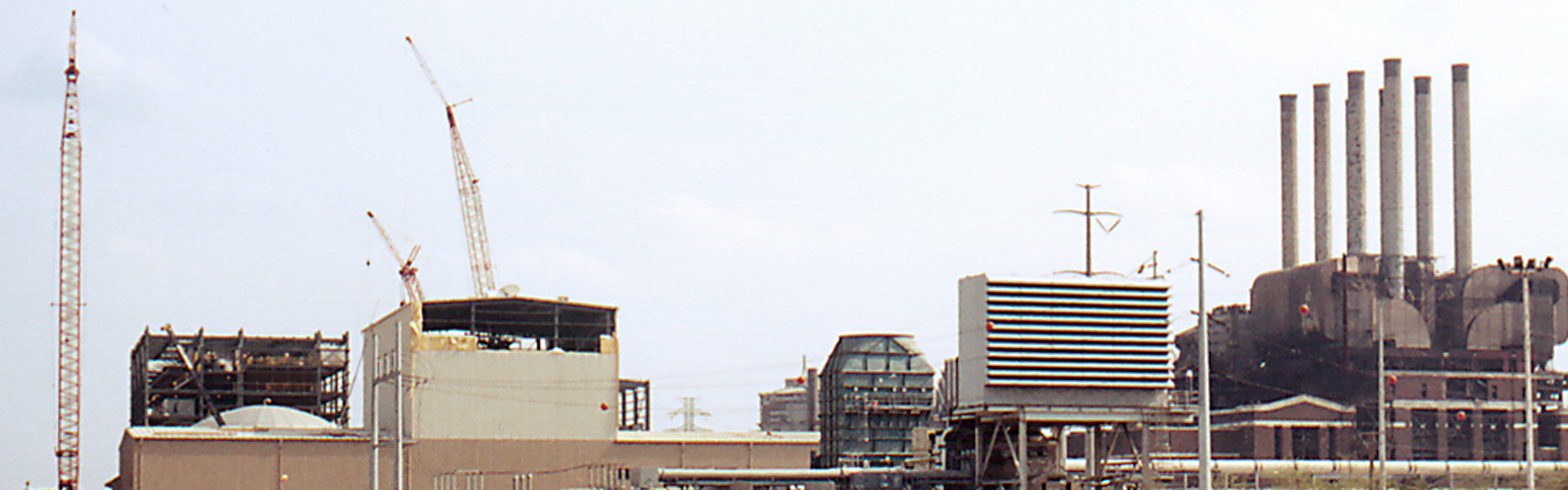
Dearborn Industrial Generation
A fast-track industrial rebuild restores critical operations after a catastrophic loss, delivering heavy-duty structural performance, crane support and long-term reliability while meeting aggressive timelines and reinforcing confidence in a high-consequence operating environment.
Project
Overview
After a 1999 explosion destroyed a power plant facility in Michigan, rebuilding the industrial complex was a massive priority and a massive challenge.
Operations had to be restored quickly, safely and with absolute confidence in long term performance. The replacement facility would not only recover lost capacity, but strengthen it.
The result was an 80,500-square-foot multi-unit complex delivered on a compressed schedule. Speed mattered, but not at the expense of precision. Each building within the complex was designed to support heavy industrial processes, demanding equipment and continuous operations.
Butler Heavy Structures provided the structural steel and cladding systems for all units except the Boiler House, ensuring consistency and reliability across the site.


The gas turbine and steam turbine buildings introduced some of the most demanding structural requirements. Welded up step crane columns were engineered to support overhead cranes rated at 65 tons and 85 tons, respectively.
These cranes are central to turbine maintenance and operation, placing significant responsibility on the primary structure. Load paths were carefully managed to deliver stability without overbuilding, reinforcing performance through engineering discipline.
Framing the gas turbine building presented additional challenges. A 35-foot roof step created complex transitions within the structure, while large air intake units required integrated support framing without interrupting crane operation or internal clearance.
The solution balanced structural depth, access and serviceability, allowing systems to coexist without conflict.
Across the complex, durability and enclosure performance were treated as nonnegotiable. Standing seam metal roof systems and metal wall panel systems were installed on all units, creating a unified exterior and dependable weather protection suited to industrial use.
The project required close coordination between trades, suppliers and sequencing teams to meet the aggressive schedule. Reconstruction progressed with intent, restoring functionality while improving resilience compared to the facility it replaced. Every decision reflected the reality of operating in an high consequence environment where downtime carries real cost.
Today, the rebuilt complex stands as a working example of recovery done right. It delivers the strength required to support heavy industrial operations, the flexibility to manage complex equipment and the assurance that comes from disciplined design and execution.


